How to write a director's treatment
A treatment is your references and your intent, bound into one document a client can hold. Here's how to write one — and how to build it straight out of your reference board.
Lamont Crook
Documentary filmmaker · Founder, High Desert Films · Adobe
What a treatment actually is
A director's treatment is a short document that presents your creative intent for a project before it's shot — the tone, the visual references, the structure, and why you're the right person to make it. It exists to put a client or collaborator inside your head: not a script, not a shot list, but the argument for how the finished piece will look, move, and feel.
The parts of a treatment
Logline
One or two sentences stating what the piece is and why it matters, before any style talk begins.
Tone & feel
The emotional register the audience should sit in — named plainly, not with mood-board adjectives alone.
Visual references
Stills, films, and photography that show — not describe — the world the piece lives in.
Structure & pacing
How the piece is shaped in time — where it opens, where it turns, where it lands.
Camera & light
The specific choices — lens, movement, practical vs. natural light — that will make the tone real on set.
Sound
The score, silence, and location sound that will carry as much of the story as the picture does.
Why you
The paragraph that states plainly why this project belongs with you, not just what you'd do with it.
Build it from a board
The natural sixth step of the craft.
- 1
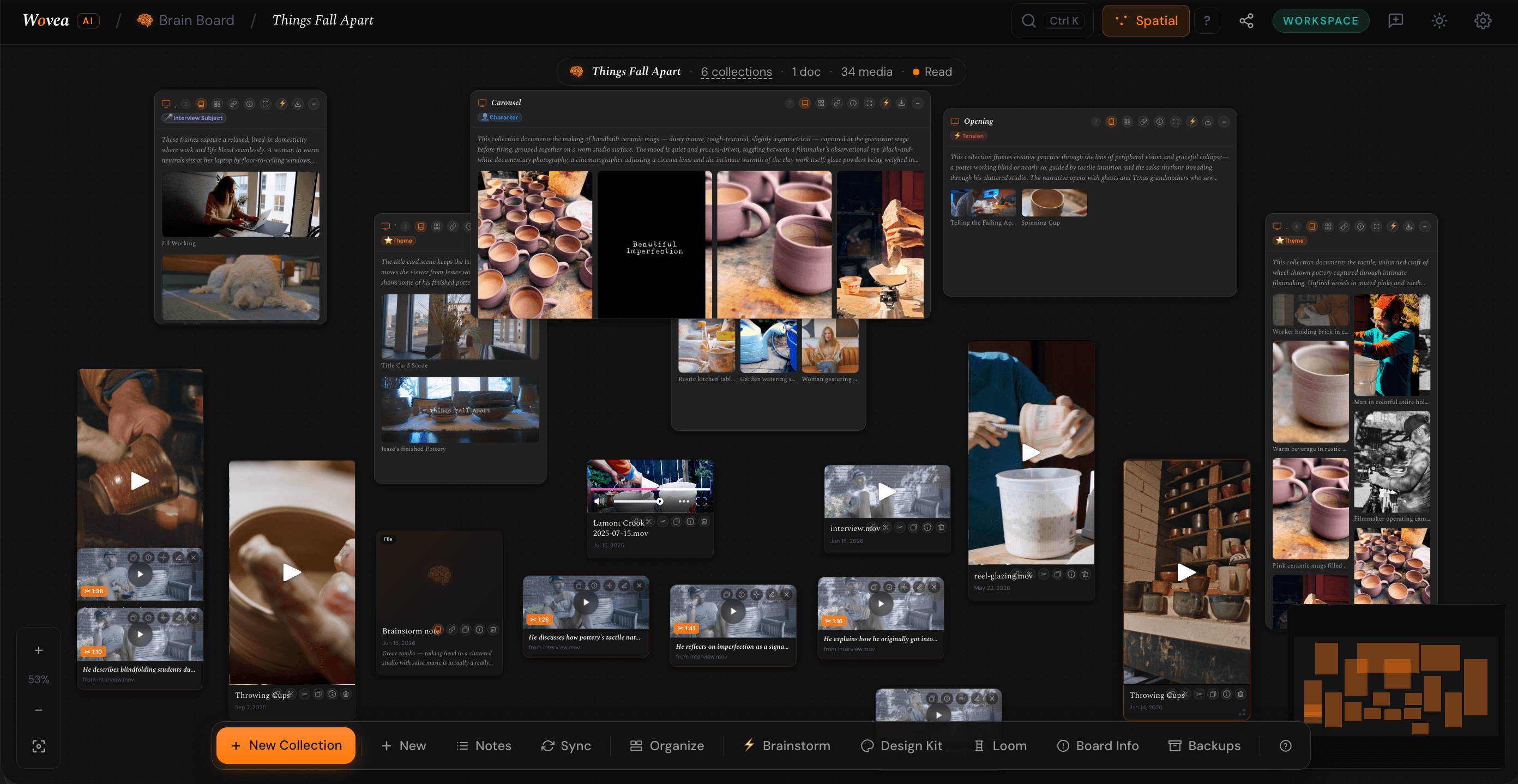
Drop your references onto a Brain Board.
- 2
Group them into collections — tone, camera, location, light.
- 3
Connect them: what supports the idea, what contradicts it, what leads to the next beat.
- 4
Generate a Design Kit from the photos themselves.
- 5
Open Loom — Wovea's output studio — and lay the treatment out.
- 6
Publish it as a page, or export a PDF.
See a real one